

SMILE Laser Eye Surgery Pretoria: The Flapless Procedure Explained
June 10, 2026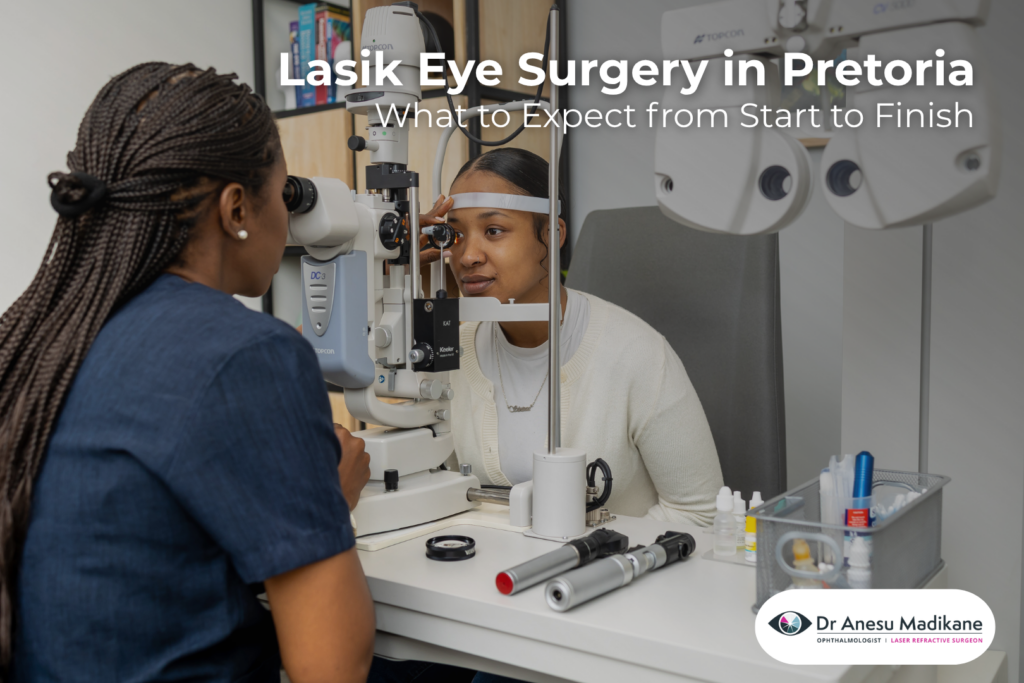
If you have spent years relying on glasses or contact lenses to get through your day, the idea of waking up and simply being able to see clearly is a life-changing prospect. LASIK eye surgery has made that a reality for millions of people around the world, and right here in Pretoria, it is more accessible than ever. Whether you are a working professional tired of foggy lenses on a winter morning or an active individual frustrated by contacts during sport, LASIK could be the solution you have been looking for.
Understanding what the procedure actually involves is one of the most important steps in deciding whether it is right for you. Many patients arrive at their first consultation with a mix of excitement and nerves, largely because they are not entirely sure what happens before, during, and after surgery. This guide walks you through the full LASIK journey at Dr Anesu Madikane’s practice in Pretoria, so you know exactly what to expect at every stage.
What is LASIK and How Does It Work?
LASIK, which stands for Laser-Assisted In Situ Keratomileusis, is a corneal refractive surgery that reshapes the tissue beneath the surface of your eye to correct your vision. The cornea is the clear front part of your eye, and when it is incorrectly shaped, light does not focus properly on your retina, which is what causes myopia (short-sightedness), hyperopia (long-sightedness), and astigmatism.
During LASIK, a precise laser creates a thin flap on the surface of the cornea. This flap is gently lifted, and an excimer laser is then used to reshape the corneal tissue underneath. Once the correction has been made, the flap is repositioned, where it naturally adheres without the need for stitches.
The entire laser treatment typically takes less than a minute per eye, which often surprises patients who have been building up to the procedure for months.
The Initial Consultation: Where It All Begins
Your LASIK journey in Pretoria begins long before any laser touches your eye. The first and most critical step is a comprehensive pre-operative assessment with Dr Madikane. This is not a routine eye test. It is an in-depth evaluation of your eye health, corneal thickness, corneal topography, pupil size, tear film quality, and overall refractive stability.
This assessment is where your candidacy is confirmed. Not everyone is a suitable candidate for LASIK, and a thorough evaluation ensures that the procedure will be both safe and effective for you specifically. If your prescription has been stable for at least 12 months, your corneas are of adequate thickness, and your eyes are in good overall health, you are likely well-placed for LASIK.
Dr Madikane trained at Stellenbosch University and the University of Pretoria, completed her Master of Surgery in Clinical Ophthalmology at the University of Edinburgh, and is a graduate of the World College of Refractive Surgery & Visual Sciences Fellowship. She also completed the Refractive Surgery Laser Forefront Course at the London Vision Clinic. This level of expertise means your assessment is thorough, personalised, and conducted with the most current understanding of refractive surgery standards.
Pre-Surgery Preparation: What You Need to Do
Once you have been confirmed as a candidate, there are a few important steps to take before your surgery date. If you wear soft contact lenses, you will need to stop wearing them at least one week before your assessment and surgery, as contact lenses can temporarily alter the shape of your cornea and affect the accuracy of your measurements. Hard or rigid gas-permeable lenses require a longer break of several weeks.
On the day of your procedure, you should arrange for someone to drive you to and from the practice. Your vision will be temporarily blurred immediately after surgery, and driving yourself is not an option. You will also be advised to arrive without eye makeup, lotions, or perfume near the eye area, as these can interfere with the sterile environment required for the procedure.
The Day of Your LASIK Surgery: A Step-by-Step Breakdown
Many patients are surprised by just how quick and straightforward the surgical experience is. Here is what typically happens on the day.
When you arrive at the practice, located at Linton’s Corner Retail Park in Equestria, Pretoria, the team will confirm your pre-operative measurements and prepare you for the procedure. Anaesthetic eye drops are applied to numb the surface of your eyes completely, so you will feel no pain during the surgery. You may feel a mild sensation of pressure at one point during the creation of the flap, but this lasts only a few seconds.
You will be asked to focus on a target light while the laser works. The laser itself emits a gentle sound and takes between 20 and 60 seconds per eye depending on your prescription. The flap is then repositioned and a shield may be placed over your eye for protection. Most patients are in and out of the surgical suite within 15 to 20 minutes for both eyes combined.
Immediately After Surgery: The First Few Hours
Once the procedure is complete, you will rest briefly at the practice before heading home. Your vision in the first few hours will likely be hazy, and your eyes may feel a gritty or slightly irritated sensation, similar to having something in your eye. This is completely normal and typically subsides within a few hours.

You will be given antibiotic and anti-inflammatory eye drops to begin immediately, along with lubricating drops to keep the eye surface comfortable during healing. It is essential to avoid rubbing your eyes in the initial days following surgery, as this can disturb the healing flap. Dr Madikane’s team will provide you with a detailed aftercare protocol to follow at home.
Most patients are advised to rest for the remainder of the day and to sleep with protective eye shields on for the first few nights.
Vision Recovery: What to Expect in the Days That Follow
One of the most exciting aspects of LASIK is how rapidly vision improves. The majority of patients notice a significant improvement in their vision within 24 hours of surgery. By the following day, many are able to return to work, provided their job does not involve heavy dust, chemicals, or prolonged screen exposure without breaks.
Your follow-up appointment, typically scheduled for the day after surgery, allows Dr Madikane to assess healing and confirm that your vision is tracking as expected. Subsequent follow-ups are scheduled at one week, one month, and three months post-surgery.
While most patients achieve their target vision quickly, it is normal for vision to fluctuate slightly in the first few weeks as the cornea fully stabilises. Dry eye symptoms are also common during this period and are managed with lubricating drops.
Your Clear Vision Journey Starts Here
LASIK eye surgery is one of the most well-researched and consistently successful elective procedures available today, and with the right specialist, the experience from consultation to recovery is straightforward and well-supported.
If you are in Pretoria and considering your options for vision correction, a consultation with Dr Anesu Madikane is the best place to start.
Frequently Asked Questions
Is LASIK painful?
LASIK is not a painful procedure. Anaesthetic eye drops are applied before surgery, which numbs the surface of the eye completely. You may experience a mild pressure sensation during flap creation, but this lasts only a few seconds. After surgery, some patients describe a gritty or uncomfortable sensation for a few hours, which settles quickly with lubricating drops and rest.
How long does LASIK last?
For most patients, the vision correction achieved by LASIK is permanent. The reshaping of the cornea does not reverse over time. However, it is important to understand that LASIK does not prevent natural age-related changes to your vision, such as presbyopia, which typically develops in your mid-40s and affects near vision. Dr Madikane will discuss long-term expectations with you during your consultation.
What is the minimum age for LASIK in South Africa?
Most ophthalmologists, including Dr Madikane, recommend that patients are at least 18 years of age before considering LASIK. More importantly, your prescription needs to have been stable for a minimum of 12 months before surgery is considered, which is why many patients undergo the procedure in their mid-to-late twenties.
Can both eyes be done on the same day?
Yes, in the vast majority of cases both eyes are treated during the same surgical session. This is the standard approach and reduces overall recovery time. Dr Madikane will confirm during your consultation whether bilateral same-day treatment is appropriate for your specific case.