

SMILE Laser Eye Surgery Pretoria: The Flapless Procedure Explained
June 10, 2026
Implantable Contact Lens Surgery in Pretoria: The Reversible Alternative to Laser
July 16, 2026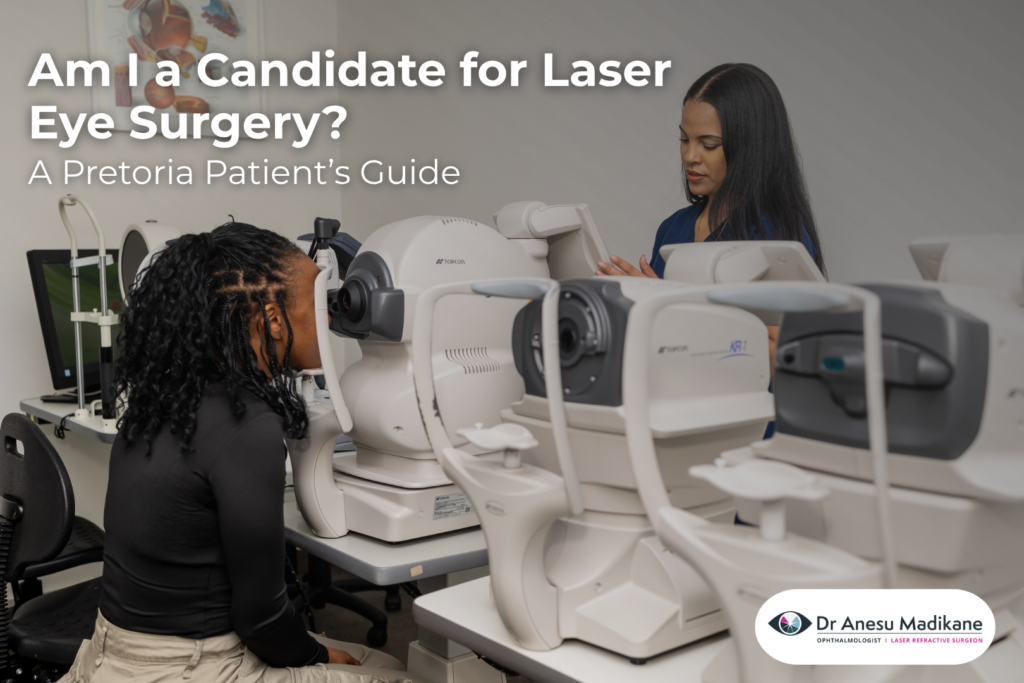
One of the most common questions Dr Anesu Madikane receives from patients is a simple but deeply important one: am I actually a good candidate for laser eye surgery
It is a question worth taking seriously, because while laser vision correction has transformed the lives of millions of people worldwide, it is not a one-size-fits-all solution. The right procedure for one person may not be the right procedure for another, and a thorough candidacy assessment is what separates a great outcome from a poor one.
The good news is that the majority of people who enquire about laser eye surgery are suitable for some form of vision correction procedure. Whether that is LASIK, SMILE, PRK, or a lens-based alternative, modern ophthalmology offers more options than ever before.
This guide walks you through the key factors that determine candidacy, what the assessment process involves, and what happens if laser surgery turns out not to be the right fit for your eyes.
The Core Requirements for Laser Eye Surgery
Before anything else, there are a few foundational criteria that apply broadly across laser eye surgery procedures. These are not arbitrary rules. They exist because meeting them is directly tied to achieving safe, stable, and effective outcomes.
Your prescription needs to have been stable for a minimum of 12 months before surgery is considered. If your glasses or contact lens prescription has been changing year on year, it suggests that your eye is still shifting, and operating on an unstable prescription increases the likelihood of regression or under-correction over time.
Most patients find that their prescription stabilises in their mid-to-late twenties, which is why this tends to be the most common age range for laser eye surgery.
You also need to be at least 18 years of age, and your prescription must fall within the treatable range of the procedure being considered. Different laser procedures have different treatment ranges, and Dr Madikane will assess during your consultation which options are appropriate based on your specific numbers.
Corneal Health and Thickness: Why It Matters
Your cornea is the foundation on which laser eye surgery is built. Every laser procedure works by removing a precise amount of corneal tissue to reshape the eye, and for that to be done safely, there needs to be enough tissue present to begin with.
Corneal thickness is measured during your pre-operative assessment using highly accurate diagnostic technology, and it plays a significant role in determining which procedure is appropriate for you.
Beyond thickness, the shape and regularity of your cornea are equally important. Corneal topography maps the surface of your eye in detail, allowing Dr Madikane to identify any irregularities that could affect the outcome of surgery or indicate an underlying condition such as keratoconus, a progressive thinning of the cornea that can make laser eye surgery unsuitable in its active form.
Patients with borderline corneal thickness or mild irregularities are not automatically excluded from vision correction. In many of these cases, a lens-based procedure such as an Implantable Contact Lens may be a safer and equally effective alternative.
Prescription Range: What Can Laser Eye Surgery Correct?
Laser eye surgery is most commonly used to correct three refractive errors: myopia, hyperopia, and astigmatism. Each procedure has a range within which it is most effective and safe, and your prescription will be assessed against these parameters during your evaluation.
For myopia, laser procedures can typically treat prescriptions ranging from mild to moderately high levels of short-sightedness. Very high prescriptions may push beyond what corneal laser surgery can safely achieve, in which case a lens-based alternative such as the Implantable Contact Lens is often the preferred route.

For hyperopia and astigmatism, the treatable ranges vary between procedures, and Dr Madikane will clarify exactly where your prescription sits during your consultation.
It is worth noting that laser eye surgery does not correct presbyopia, which is the age-related loss of near vision that most people begin to notice in their early to mid-forties. If you are in this age group and want to reduce your dependence on both distance and reading glasses, Refractive Lens Exchange may be a more appropriate conversation to have.
Dry Eye Disease: A Factor Worth Discussing
Dry eye is one of the most frequently raised concerns during laser eye surgery consultations, and for good reason. Laser procedures, particularly LASIK, can temporarily reduce corneal sensitivity and affect tear production in the months following surgery. For patients who already experience significant dry eye symptoms, this can be an important factor in determining which procedure is most appropriate.
If you suffer from chronic dry eye disease, this does not necessarily disqualify you from laser eye surgery altogether. It does, however, mean that your tear film quality will be carefully evaluated as part of your assessment.
In some cases, managing dry eye proactively before surgery can make a meaningful difference to both the surgical outcome and your post-operative comfort. SMILE, which severs fewer corneal nerves than LASIK, is often considered a more favourable option for patients with dry eye concerns.
Dr Madikane takes a conservative and thorough approach to this aspect of the assessment, because getting it right before surgery is far better than managing complications after it.
General Health and Lifestyle Considerations
Your overall health also plays a role in determining your suitability for laser eye surgery. Certain autoimmune conditions, such as rheumatoid arthritis or lupus, can affect healing and may make laser surgery inadvisable. Conditions that compromise the immune system more broadly are also taken into account during the assessment process.

From a lifestyle perspective, patients who participate in high-impact contact sports may benefit from discussing a flapless procedure such as SMILE, which eliminates the small but real risk of flap displacement that exists with LASIK. Similarly, patients who work in environments with significant dust, chemical exposure, or physical risk to the eye area may find that the flapless nature of SMILE offers greater peace of mind in their day-to-day life after surgery.
Pregnancy and breastfeeding are also periods during which laser eye surgery is not recommended, as hormonal changes can temporarily affect the stability of your prescription and corneal shape. It is advisable to wait until your prescription has been stable for at least 12 months post-pregnancy before pursuing an assessment.
What Happens If You Are Not a Candidate for Laser Surgery?
Being told that laser eye surgery is not the right option for you is not the end of the road. It simply means that a different approach is needed, and modern ophthalmology has excellent alternatives available.
The Implantable Contact Lens is a highly effective lens-based solution for patients with high prescriptions or thinner corneas who are not suitable for laser surgery. It is a reversible procedure that preserves your corneal tissue entirely.
Refractive Lens Exchange, which replaces the eye’s natural lens with a premium artificial lens, is another excellent option for patients with very high prescriptions or those in the presbyopic age range.
Dr Madikane’s approach is always to find the right solution for your eyes, not simply to recommend the most popular one. Every assessment is a conversation, and every recommendation is based on what is genuinely in your best interest.
Your Journey to Clearer Vision Begins With One Assessment
Candidacy for laser eye surgery is not a simple yes or no answer. It is a detailed, personalised evaluation that takes into account your prescription, corneal health, tear film, lifestyle, and overall wellbeing.
The only way to know for certain whether laser eye surgery is right for you is to sit down with a specialist ophthalmologist who can assess your eyes thoroughly and guide you toward the best possible outcome.
Book your free assessment with Dr Anesu Madikane at her practice in Linton’s Corner Retail Park, Equestria today and get the answers you need to make a confident, informed decision about your vision.
Frequently Asked Questions
How do I know if my prescription is stable enough for laser eye surgery?
The general guideline is that your prescription should not have changed by more than 0.50 dioptres over the preceding 12 months. The most reliable way to confirm this is to bring your last two or three pairs of spectacle or contact lens prescriptions to your consultation. Dr Madikane will review these alongside your assessment results to determine whether your prescription meets the stability requirement.
Can I have laser eye surgery if I have astigmatism?
Yes, astigmatism on its own is not a disqualifying factor for laser eye surgery. Both LASIK and SMILE are able to correct myopic astigmatism, and LASIK can also address hyperopic astigmatism. The key factors are the degree of astigmatism, the overall prescription, and the health of your cornea. These will all be evaluated during your pre-operative assessment.
What if I have been told previously that I am not a candidate?
Technology in refractive surgery advances continuously, and assessment criteria have evolved alongside it. If you were told years ago that you were not suitable for laser eye surgery, it is worth booking a fresh assessment with a specialist ophthalmologist. What was outside the treatable range previously may now be within reach, or an alternative procedure may have become available that suits your eyes better.
Is the candidacy assessment free?
At Dr Madikane’s practice, you are encouraged to book a free assessment to begin the conversation about your vision correction options. This initial appointment is an opportunity to understand your eyes in detail and to explore which procedures may be appropriate for you, without any pressure or obligation to proceed.