

What is PRK/LASEK? When Surface Laser Surgery is the Better Choice
July 28, 2026
How Much Does LASIK Cost in South Africa? (2026 Guide)
August 4, 2026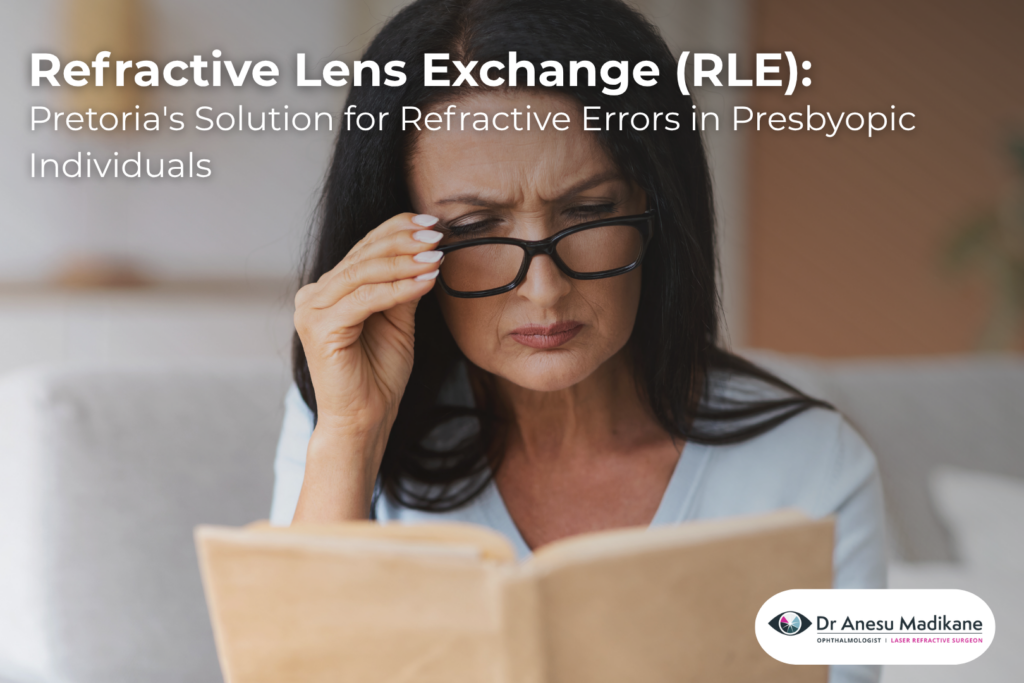
There is a moment that most people over the age of 45 know well. You pick up your phone, a menu, or a document, and you find yourself instinctively holding it further away to bring the text into focus. You might have perfect distance vision, or you might already wear glasses for short-sightedness, but either way, the reading glasses have started making an appearance, and they are becoming harder to avoid. This age-related change in near vision is called presbyopia, and it is one of the most universal visual experiences in adult life.
For many years, the standard response to presbyopia was reading glasses, bifocals, or progressive lenses. These solutions work, but they come with compromises that a growing number of patients are no longer willing to accept. Refractive Lens Exchange offers a surgical alternative that addresses both the underlying refractive error and the presbyopia at its source, delivering a genuine and lasting improvement in vision across multiple distances without the daily reliance on spectacles.
Dr Anesu Madikane offers Refractive Lens Exchange from her practice in Pretoria, and for the right patient, it is one of the most transformative procedures in modern ophthalmology.
What is Refractive Lens Exchange?
Refractive Lens Exchange, commonly abbreviated to RLE, is a surgical procedure in which the eye’s natural lens is removed and replaced with a premium artificial intraocular lens. It uses the same surgical technique as cataract surgery, but it is performed on a clear, non-cataractous lens for the purpose of correcting refractive error and reducing dependence on glasses, rather than to treat a cloudy cataract.
The natural lens of the eye is responsible for a significant portion of the eye’s focusing power. In youth, it is flexible and able to change shape to focus on objects at varying distances, a process called accommodation. As we age, the lens gradually loses this flexibility, which is what causes presbyopia. By the time most people reach their mid-forties, the natural lens has become rigid enough that near focus requires the assistance of reading glasses to compensate for its lost flexibility.
RLE replaces this aging, inflexible lens with a premium intraocular lens that is selected to meet the patient’s specific visual needs. Depending on the lens chosen, RLE can correct distance vision, near vision, intermediate vision, or all three simultaneously, offering patients a meaningful reduction in their reliance on glasses across the full range of daily visual tasks.
How is RLE Different from Cataract Surgery?
This is one of the most frequently asked questions when patients first learn about RLE, and it is a fair one because the surgical technique used in both procedures is essentially the same. The key difference lies in the indication for surgery rather than the procedure itself.
Cataract surgery is performed when the eye’s natural lens has become cloudy enough to impair vision to a clinically significant degree. The primary goal is to restore clarity by removing the cataract. Refractive Lens Exchange is performed on a clear natural lens, with the primary goal being the correction of refractive error and the improvement of functional vision across multiple distances. It is a proactive, elective procedure rather than a medically necessary one.
One of the significant secondary benefits of RLE is that, because the natural lens is removed and replaced with an artificial one, the patient can never develop a cataract in that eye in the future. This is a meaningful long-term advantage, particularly for patients in their forties and fifties who might otherwise anticipate cataract surgery in the decades ahead. With RLE, that future procedure is effectively pre-empted.
Who is RLE Best Suited For?
RLE is most commonly recommended for patients in their mid-forties and beyond who are experiencing presbyopia and want to reduce or eliminate their dependence on reading glasses. It is also an excellent option for patients with high prescriptions, either high myopia or high hyperopia, who are not suitable candidates for corneal laser surgery such as LASIK or SMILE.
Patients with very high levels of long-sightedness are particularly well-served by RLE. High hyperopia is challenging to treat with corneal laser surgery because of the amount of tissue manipulation required, and the results can be less stable over time. RLE addresses the refractive error at the level of the lens, which is a more direct and often more predictable approach for this prescription group.
Similarly, patients with high myopia who have been assessed as unsuitable for laser eye surgery, and who do not meet the criteria for ICL surgery, may find that RLE is the most appropriate vision correction solution for their needs. The range of prescriptions that can be addressed through lens-based surgery is considerably broader than what corneal laser surgery can safely accommodate.
Patients who are already in the cataract risk age range, typically from the mid-fifties onward, are also natural candidates for RLE, as the procedure addresses both the refractive goal and the future cataract risk in a single surgical event.
Premium Lens Options for RLE: Choosing the Right Lens
The lens selection process is one of the most important and personalised aspects of the RLE journey. The intraocular lens chosen for your procedure has a direct and lasting impact on the quality and range of your vision after surgery, and it is a decision that deserves careful thought and thorough guidance from Dr Madikane.
Multifocal intraocular lenses are designed to provide clear vision at distance, intermediate, and near simultaneously. They achieve this by incorporating multiple focal zones into a single lens, allowing the visual system to select the appropriate focal point for the task at hand. For patients who want the greatest possible freedom from glasses across all distances, a multifocal lens is often the most compelling choice.
Trifocal lenses refine this further by optimising three distinct focal points, generally distance, arm’s length, and near, which tends to produce a more continuous and natural visual experience than earlier generation multifocal designs. Extended Depth of Focus lenses work by elongating the focal range rather than creating distinct zones, providing smooth and seamless vision from distance through to intermediate, with functional near vision for most tasks.
For patients with significant astigmatism, toric intraocular lenses are incorporated into the surgical plan to correct the astigmatism at the same time as the lens exchange, delivering a more complete refractive outcome without the need for additional laser treatment. Dr Madikane uses advanced biometry and a detailed discussion of your visual lifestyle to guide lens selection, ensuring that the chosen lens is genuinely aligned with how you live and what you need from your vision.
What Does the RLE Procedure Involve?
The RLE procedure is performed under local anaesthetic, meaning the eye is completely numbed while you remain comfortably awake throughout. The surgery itself typically takes around 15 to 20 minutes per eye and is conducted with a high level of precision using microsurgical techniques.
A small incision is made at the edge of the cornea, through which an ultrasound probe is inserted to break up and gently remove the natural lens using a technique called phacoemulsification.
The premium intraocular lens, which has been folded for insertion, is then placed into the natural lens capsule where it unfolds and is carefully positioned. The incision is so small that it seals naturally without the need for stitches.
The procedure is performed on one eye at a time, with the second eye typically treated one to two weeks after the first. This interval allows Dr Madikane to assess the outcome in the first eye and confirm that the lens power and positioning are delivering the expected visual result before proceeding with the second eye.
Both eyes are fully treated within a short overall timeframe, and most patients find the experience far more straightforward than they had anticipated.
RLE Recovery: What to Expect
Recovery after RLE is generally smooth and progresses quickly. Most patients notice a meaningful improvement in their vision within the first day or two following surgery, though the visual experience in the early days can include some mild blurring, light sensitivity, and haloes or glare around lights, particularly at night.
These effects are a normal part of the adjustment process and typically diminish steadily over the first few weeks.
For patients who receive a multifocal or trifocal lens, there is an additional period of neuroadaptation during which the brain learns to process the visual information from the new lens. This process is usually complete within four to eight weeks, after which most patients report a natural and comfortable visual experience across all distances.
You will be prescribed antibiotic and anti-inflammatory eye drops to use consistently in the weeks following surgery, and follow-up appointments with Dr Madikane will be scheduled at regular intervals to monitor your healing and visual progress.
Most patients are able to return to light daily activities within two to three days of surgery, with a gradual return to more demanding tasks as healing progresses.
A Permanent Solution to a Universal Problem

Presbyopia is one of the most common visual changes in adult life, but accepting a lifetime of reading glasses is no longer the only option available to you. Refractive Lens Exchange offers a permanent, premium solution that addresses the root cause of the problem rather than simply compensating for it.
For patients who are in the right age range, carry the right prescription profile, and are looking for a lasting improvement in their quality of vision through lens-based refractive surgery in Pretoria, RLE is a procedure that genuinely delivers. The results, when achieved through careful assessment and precise lens selection, can be life-changing in the most practical and meaningful sense.
Book your free assessment with Dr Anesu Madikane at Linton’s Corner Retail Park, Equestria today and find out whether Refractive Lens Exchange is the right solution to give you the clear, comfortable vision you deserve across every distance and every moment of your day.
Frequently Asked Questions
Is RLE covered by medical aid in South Africa?
RLE is generally considered an elective procedure and is not typically covered by medical aid in South Africa, as it is performed on a clear lens for refractive purposes rather than to treat a medically necessary condition.
The premium lens component of the procedure is also an out-of-pocket cost in most cases. Dr Madikane’s practice will provide you with a comprehensive cost breakdown during your consultation so that you can plan accordingly.
Can RLE be reversed if I am not happy with the outcome?
Unlike ICL surgery, RLE is not considered a reversible procedure. Once the natural lens has been removed and replaced, the process cannot simply be undone. This is why careful pre-operative assessment, thorough lens selection, and realistic expectation-setting are so important before proceeding with RLE.
Dr Madikane takes a conservative and honest approach to this conversation, ensuring that every patient who moves forward with RLE does so with a clear and accurate understanding of what the procedure can and cannot achieve.
At what age is RLE most appropriate?
RLE is most commonly performed in patients from their mid-forties onward, when presbyopia has become functionally significant and the natural lens has lost most of its accommodative flexibility.
There is no fixed upper age limit for RLE, though patients in their late fifties and sixties who have developed early cataracts may find that the distinction between RLE and refractive cataract surgery becomes less meaningful. Dr Madikane will advise you on the most appropriate timing and approach based on your age, prescription, and lens status.
Will I still need glasses after RLE?
The goal of RLE with a premium multifocal or trifocal lens is to significantly reduce dependence on glasses across all distances. The majority of patients achieve meaningful freedom from spectacles for most daily tasks following RLE. However, it is important to understand that no procedure can guarantee complete independence from glasses in every situation.
Some patients find they still benefit from glasses for prolonged fine reading or very low-light tasks. Dr Madikane will set clear and honest expectations about what your chosen lens is likely to achieve based on your individual measurements and visual demands.